

Research programme
How do change agents pursue entrepreneurial opportunities?
Dr Glory Enyinnaya studies how entrepreneurial change agents recognise opportunities in institutional gaps, mobilise trust and legitimacy, and build ventures capable of sustained, responsible performance in complex African environments.

Core question
Entrepreneurial Change Readiness
Entrepreneurial Change Readiness reframes readiness as more than access to finance. It is the capacity to initiate and respond to change in ways that create advantage, minimise risk and sustain performance. The research programme connects entrepreneurship, institutional theory, strategy and responsible innovation.
From recognising a values-worthy opportunity to earning legitimacy, building trusted offers and growing conscientiously: what practices enable change agents to create durable value?
A different readiness logic
Investor Readiness vs Change Readiness
Investor Readiness asks whether an opportunity can attract capital and produce scalable returns. Change Readiness asks whether a change agent can earn the trust, legitimacy and sustained participation required to alter how a constrained system works. The two lenses can complement each other—but they do not ask the same questions.
Investor Readiness
Can the venture demonstrate attractiveness, traction, execution capability, scalability and returns?
Change Readiness
Can the venture demonstrate necessity, trustworthiness, legitimacy, institutional endurance and responsible change?
| Practice | Investor Readiness lens | Change Readiness lens |
|---|---|---|
| Opportunity recognition | Valuation-drivenValuation-Driven Opportunity RecognitionIs this opportunity attractive, scalable and investable? | Values-basedValues-Based Opportunity RecognitionIs this opportunity necessary, legitimate and capable of changing how the system works? |
| Product development | Traction-drivenTraction-Driven Product DevelopmentIs this product competitive, scalable and investable? | Trust-centredTrust-Centred Product DevelopmentIs this product trustworthy, acceptable and capable of changing how the system works? |
| Brand identity | Perception-drivenPerception-Driven Brand IdentityDoes this brand attract, convert and retain customers? | Performance-drivenPerformance-Driven Brand IdentityDoes this brand earn trust, legitimacy and sustained support within a constrained institutional environment? |
| Marketing strategy | Visibility-drivenVisibility-Driven MarketingDoes marketing efficiently attract, convert and scale customers? | Outcome-verifiedOutcome-Verified MarketingDoes marketing build understanding, credibility and permission for change? |
| Team building | Capability-centricCapability-Centric Team BuildingDoes this team execute, scale and deliver results? | Culture-groundedCulture-Grounded Team BuildingCan this team hold trust, manage relationships and steward change over time? |
| Strategic partnerships | Leverage-ledLeverage-Led PartnershipsDoes the partnership generate mutual value? | Legitimacy-ledLegitimacy-Led PartnershipsDoes the partnership further mutual values and confer legitimate support for change? |
| Growth strategy | Velocity-drivenVelocity-Driven Growth StrategyIs this venture profitable, scalable and attractive to capital? | ConscientiousConscientious Growth StrategyCan this venture survive, remain credible and endure institutional stress? |
Research framework
The seven pillars
The framework is organised as seven linked practices. Each pillar will host a twelve-article explanatory series; the publication slots are prepared below and will be completed as the articles are supplied.
Values-Based Opportunity Recognition
Recognising unmet needs and institutional gaps through a values-led lens, with attention to human dignity, stakeholder welfare and the common good.
Read the book chapter at Springer Nature →
12-article explanatory series
- Article 01 — Why Promising African Startups Fail; Scalability Is Not Suitability
- Article 02 — Why Preventing Startup Failure Is Everyone’s Responsibility
- Article 03 — The Hidden Cost of Startup Failure in Africa
- Article 04 — How to Find Better Business Opportunities; Move from TAM to TAV
- Article 05 — How Entrepreneurs are Taught to Recognise Opportunites.
- Article 06 — Why A Good Opportunity is Not Enough.
- Article 07 — Your Startup Has Traction. So why is it failing?
- Article 08 — Trust Before Traction: 4 Fintechs That Cracked the Startup Legitimacy Code
- Article 09 — Forget the Hype: How Startup Legitimacy Builds Businesses that Last
- Article 10 —Your Startup Has Customers. But Does it Have Permission to Exist?
- Article 11 — title and link to be supplied.
- Article 12 — title and link to be supplied.
Trust-Centred Product Development
Turning opportunity into products and services that reduce uncertainty, demonstrate reliability and earn stakeholder confidence.
Read the book chapter at Springer Nature →
12-article explanatory series
- Article 01 — title and link to be supplied.
- Article 02 — title and link to be supplied.
- Article 03 — title and link to be supplied.
- Article 04 — title and link to be supplied.
- Article 05 — title and link to be supplied.
- Article 06 — title and link to be supplied.
- Article 07 — title and link to be supplied.
- Article 08 — title and link to be supplied.
- Article 09 — title and link to be supplied.
- Article 10 — title and link to be supplied.
- Article 11 — title and link to be supplied.
- Article 12 — title and link to be supplied.
Performance-Driven Brand Identity
Building a credible identity around demonstrated competence, delivery discipline and evidence of performance.
Read the book chapter at Springer Nature →
12-article explanatory series
- Article 01 — title and link to be supplied.
- Article 02 — title and link to be supplied.
- Article 03 — title and link to be supplied.
- Article 04 — title and link to be supplied.
- Article 05 — title and link to be supplied.
- Article 06 — title and link to be supplied.
- Article 07 — title and link to be supplied.
- Article 08 — title and link to be supplied.
- Article 09 — title and link to be supplied.
- Article 10 — title and link to be supplied.
- Article 11 — title and link to be supplied.
- Article 12 — title and link to be supplied.
Outcome-Verified Marketing Strategy
Taking verified customer and stakeholder outcomes to market—making proof, not promise, the basis of persuasion.
Read the book chapter at Springer Nature →
12-article explanatory series
- Article 01 — title and link to be supplied.
- Article 02 — title and link to be supplied.
- Article 03 — title and link to be supplied.
- Article 04 — title and link to be supplied.
- Article 05 — title and link to be supplied.
- Article 06 — title and link to be supplied.
- Article 07 — title and link to be supplied.
- Article 08 — title and link to be supplied.
- Article 09 — title and link to be supplied.
- Article 10 — title and link to be supplied.
- Article 11 — title and link to be supplied.
- Article 12 — title and link to be supplied.
Culture-Grounded Team Building
Developing teams whose roles, capabilities and operating norms are aligned with purpose and the realities of their institutional context.
Read the book chapter at Springer Nature →
12-article explanatory series
- Article 01 — title and link to be supplied.
- Article 02 — title and link to be supplied.
- Article 03 — title and link to be supplied.
- Article 04 — title and link to be supplied.
- Article 05 — title and link to be supplied.
- Article 06 — title and link to be supplied.
- Article 07 — title and link to be supplied.
- Article 08 — title and link to be supplied.
- Article 09 — title and link to be supplied.
- Article 10 — title and link to be supplied.
- Article 11 — title and link to be supplied.
- Article 12 — title and link to be supplied.
Legitimacy-Led Partnerships
Forming relationships that confer trust, access, resources and institutional support while protecting the integrity of the venture.
Read the book chapter at Springer Nature →
12-article explanatory series
- Article 01 — title and link to be supplied.
- Article 02 — title and link to be supplied.
- Article 03 — title and link to be supplied.
- Article 04 — title and link to be supplied.
- Article 05 — title and link to be supplied.
- Article 06 — title and link to be supplied.
- Article 07 — title and link to be supplied.
- Article 08 — title and link to be supplied.
- Article 09 — title and link to be supplied.
- Article 10 — title and link to be supplied.
- Article 11 — title and link to be supplied.
- Article 12 — title and link to be supplied.
Conscientious Growth Strategy
Scaling with discipline: integrating ethics, impact, resilience and institutional durability into decisions about growth.
Read the book chapter at Springer Nature →
12-article explanatory series
- Article 01 — title and link to be supplied.
- Article 02 — title and link to be supplied.
- Article 03 — title and link to be supplied.
- Article 04 — title and link to be supplied.
- Article 05 — title and link to be supplied.
- Article 06 — title and link to be supplied.
- Article 07 — title and link to be supplied.
- Article 08 — title and link to be supplied.
- Article 09 — title and link to be supplied.
- Article 10 — title and link to be supplied.
- Article 11 — title and link to be supplied.
- Article 12 — title and link to be supplied.
Publications
Journal and practitioner articles
What African Fintech Startups Can Teach Silicon Valley About Longevity
Glory Enyinnaya and Olamitunji Dakare. Based on research with more than 200 senior executives in African fintech, the article contrasts investor readiness with the deeper capability of change readiness.
Google Scholar
Browse the current record of journal articles, book chapters, working papers and citations.
Author and article profile
Browse my Springer Nature author profile, articles and contributions for researchers and practitioners.
Books
Research books and forthcoming work
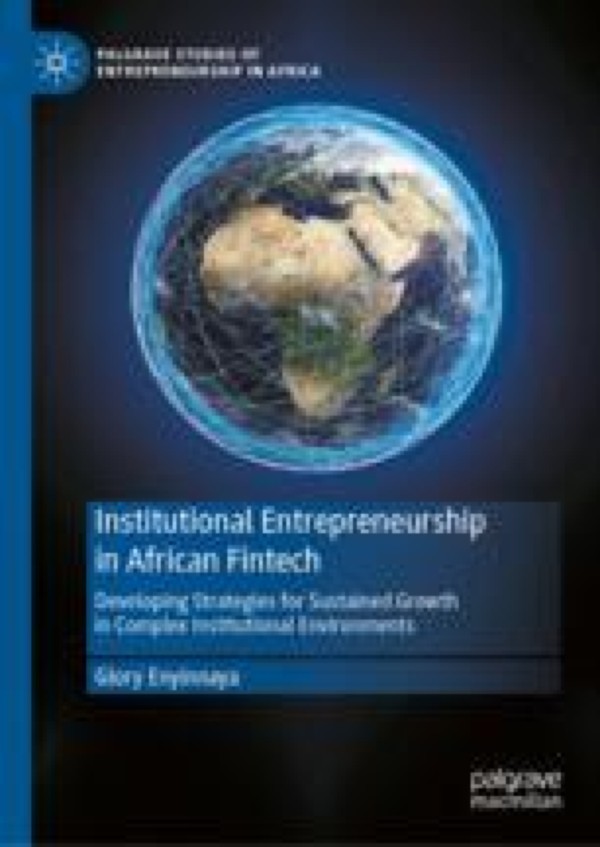
Institutional Entrepreneurship in African Fintech
Developing Strategies for Sustained Growth in Complex Institutional Environments. A research-based account of how African fintech entrepreneurs create markets, earn legitimacy and change institutions.
Cambridge University Press Elements
Glory Enyinnaya · Forthcoming
Recognizing Opportunity Where Markets Fail
Values-Based Opportunity Recognition in African Education. A Cambridge University Press Element in the Reinventing Capitalism series. The research draws on comparative cases and a corpus of African entrepreneurial journeys.
Cover supplied
Mastering the Change Process
How to Influence Stakeholders, Manage Resistance and Embed Change in Any Organisation. A practice-based guide built around David Mbang, a senior manager leading an enterprise transformation at AZ Foods.
The final supplied cover will replace this temporary panel once it is added to the website’s media library.
Selected scholarship
Book chapters
Each chapter links to its publisher or the book’s online retail page.
Family-Owned Businesses in DEMs (Africa): A Theoretical Model Analysis
In Family-Owned Business in Africa: Management, Strategy and Innovation. Examines African family-owned businesses through agency, stewardship and social-capital theories, with attention to governance, professionalisation, succession and sustainability.
Human Quality Treatment: The Ethics of Respect and Team Growth
With Rose Ogbechie, in Business Ethics in Africa, Volume I.
Platforms and Female Entrepreneurship in Africa: Case Studies from Nigeria
In Africa’s Platforms and the Evolving Sharing Economy.
Change Leaders in the Public Sector
With Franca Ovadje, in Routledge Handbook of Organizational Change in Africa.
Teaching scholarship
Cases and teaching notes
Practice-based materials for teaching entrepreneurship, strategy, digital operations, institutional complexity, organisational change and business ethics.
KleosPay
A classroom case on an African fintech venture and the institutional work required to build trust, adoption and growth. Submitted to the GBSN Case Writing Competition.
Kleos Africa
A digital social-innovation case centred on conversion, product–market fit and the tension between revenue and impact. The teaching note supports undergraduate, MBA and executive classes in entrepreneurship, e-commerce, digital marketing and operations.
David Mbang at AZ Foods
A six-stage fictional case sequence embedded in Mastering the Change Process: stakeholder analysis, impact assessment, planning, execution and reinforcement as David leads Project Spring, an enterprise transformation at AZ Foods.
Building Castles in the Air
Based on a true case from the Nigerian entrepreneurship ecosystem. Dr Amara Ekeh must navigate broken commitments, diverted resources and institutional pressure without abandoning integrity. Designed for discussion of strategy execution, institutional alignment, ethical complexity and pragmatic idealism.
In progress
Current research projects
Entrepreneurial Change Readiness
Systematic literature review, conceptual reconceptualisation and scale development.
The Seven Pillars
Clarifying the mechanisms, boundary conditions and outcomes of seven institutional-entrepreneurship practices.
Values-Based Opportunity Recognition
Comparative case research on how African change agents recognise opportunities where markets and institutions fail.